
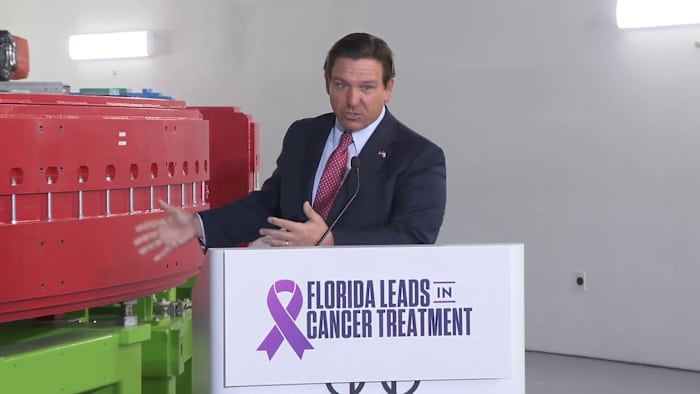
In a historic move to advance cancer treatment in the United States, Florida Governor Ron DeSantis and First Lady Casey DeSantis unveiled the groundbreaking carbon ion therapy program at Mayo Clinic in Jacksonville. This announcement marks a significant milestone in the fight against cancer, positioning Florida as a leader in innovative medical therapies.
Gov. DeSantis emphasized the importance of this pioneering therapy during a news conference at Mayo Clinic. He described carbon ion therapy as one of the most advanced forms of radiation treatment globally, previously proven effective in countries like Japan. The therapy specifically targets aggressive and difficult-to-treat cancers, offering hope to patients who have not responded well to traditional radiation treatments.
First Lady Casey DeSantis, a cancer survivor herself, expressed her personal connection to the cause and highlighted the significance of investing in cutting-edge cancer initiatives like the carbon ion therapy program. Emphasizing the state's commitment to providing top-tier medical options, she commended Florida's efforts to bring this state-of-the-art treatment to residents, underscoring the impact it will have on those facing challenging forms of cancer.
The partnership between Mayo Clinic and Florida exemplifies a strategic approach to cancer care, with Mayo Clinic President and CEO Dr. Kent Thielen joining the announcement to underscore the institution's commitment to advancing medical technologies. By introducing carbon ion therapy alongside proton therapy at their Jacksonville facility, Mayo Clinic is poised to revolutionize cancer treatment not just in Florida but across the Western Hemisphere.
The innovative carbon ion therapy program is part of a broader initiative to enhance cancer research and treatment in Florida. Under Governor DeSantis' leadership, the state has significantly increased funding for cancer programs, including a robust investment in research and development. The Casey DeSantis Cancer Research Program has played a pivotal role in solidifying Florida's reputation as a national hub for cutting-edge cancer research and therapeutic solutions.
Mayo Clinic's recent expansion with the Duan Family Building further signifies the institution's commitment to offering comprehensive cancer care. This state-of-the-art facility is uniquely equipped to provide an array of advanced treatments, including photon therapy, immunotherapy, CAR-T cell therapy, and specialized cancer services. The integration of carbon ion therapy into Mayo Clinic's offerings sets a new standard for cancer treatment in the region, promising hope for patients facing the most challenging diagnoses.
Looking ahead, the first patients to receive carbon ion therapy at Mayo Clinic Jacksonville are expected to undergo treatment starting in 2028, paving the way for more effective and targeted care delivery. By combining cutting-edge technologies with a patient-centric approach, Mayo Clinic is poised to transform the landscape of cancer treatment in the US, offering new possibilities for those battling complex and aggressive forms of the disease.
In conclusion, Florida's launch of the carbon ion therapy program represents a significant stride in advancing cancer treatment options in the country. With a focus on innovation, research, and patient care, this initiative underscores the state's commitment to addressing the challenges posed by cancer and providing hope to individuals and families impacted by the disease.