
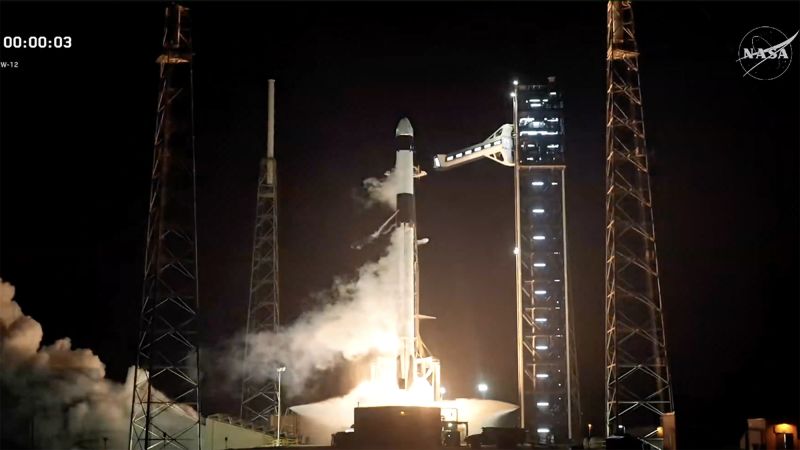
A recent space mission has garnered attention as a SpaceX capsule embarked on its journey to the International Space Station cISSc with four astronauts aboard. This endeavor aims to replenish the orbiting laboratory's staff after a month of operations with limited crew.
The mission, named Crew-12, commenced at approximately 5:17 a.m. ET from the Cape Canaveral Space Force Station in Florida. The spacecraft is anticipated to dock with the ISS the following day, amplifying the station's operational capabilities.
NASA, which collaborates with SpaceX for crew transportation services, expedited the Crew-12 launch due to the staffing constraints faced by the ISS. Nevertheless, adverse weather conditions along the rocket's flight path forced the agency to postpone two potential launch windows on preceding days.
The ISS has been operating below its desired seven-person capacity since mid-January, hosting only three crew members. This shortfall underscores the significance of maintaining a robust crew presence to maximize the value and productivity of the space station, which costs approximately $3 billion annually to operate and maintain.
Following a prior SpaceX crew mission cCrew-11c that encountered an urgent return to Earth due to a medical concern involving an unidentified crew member, NASA Administrator Jared Isaacman praised the swift and professional response of the team involved in managing the situation. The agency's emphasis on safety and preparedness was evident during the incident, demonstrating NASA's commitment to astronaut well-being.
The Crew-12 mission comprises NASA's Jessica Meir and Jack Hathaway, European Space Agency astronaut Sophie Adenot, and Russian cosmonaut Andrey Fedyaev. Despite the absence of a direct handover with the departing Crew-11 astronauts, the incoming crew managed to exchange essential information with their predecessors on the ground.
With aspirations to conduct various research projects during their approximate eight-month stay aboard the ISS, the Crew-12 astronauts will engage in studies ranging from ultrasound assessments of blood vessels to pharmaceutical research addressing pneumonia-causing bacteria. Additionally, they will explore the effects of abrupt gravity changes on human physiology and cognition through simulated lunar landing exercises.
NASA's vision for leveraging commercial spaceflights for research endeavors marks a significant step toward fostering innovative advancements in space exploration. While the current staffing situation on the ISS poses challenges, NASA envisions a future with multiple commercial space stations in low Earth orbit, complementing the agency's deep space exploration aspirations.
The Crew-12 mission signifies a crucial step in advancing research capabilities aboard the ISS. It underscores the collaborative efforts between NASA and its commercial partners, paving the way for enhanced scientific discoveries and advancements in human spaceflight. As Crew-12 embarks on its journey to the ISS, the mission embodies the spirit of shared exploration and discovery that defines humanity's enduring curiosity about the universe beyond Earth.