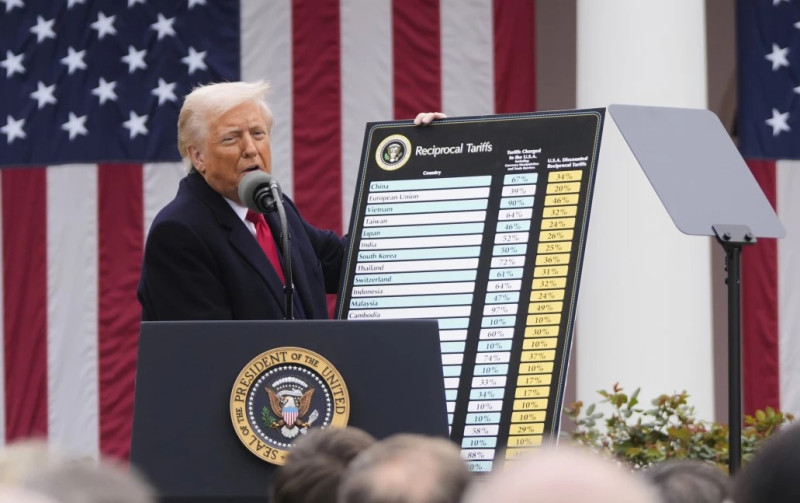
In the world of cryptocurrency trading, Bitcoin has experienced a slight dip, falling back towards $67,000 during Sunday trading. This decline comes amidst renewed trade uncertainty, with investors grappling with the implications of fresh tariff escalation and a shifting legal landscape in the United States. At the time of writing, BTC was trading around $67,526, marking a decrease of about 1.4% over the past 24 hours and roughly 2.1% for the week. This movement follows President Donald Trump's decision to increase the global tariff rate to 15% from 10%, despite a recent Supreme Court ruling that struck down earlier emergency trade measures.
The Supreme Court ruling was initially seen as a constraint on Washington's ability to impose comprehensive tariffs ahead of Trump's scheduled visit to Beijing. However, in response, the administration opted to raise the global rate, keeping the pressure on trade partners even as the legal grounds for such actions remain contentious. This decision has subjected China, among others, to the same 15% levy applied to U.S. allies, within a 150-day timeframe. This situation has left markets grappling with both escalating tensions and legal uncertainties, a combination that typically curbs risk appetite.
The impact of this trade friction is not limited to Asia alone. European lawmakers have also expressed reservations regarding advancing the Turnberry Agreement, signaling a desire for clearer commitments from Washington on trade policies before proceeding. The atmosphere remains tense and uncertain, influencing various sectors, including cryptocurrencies.
In the crypto market, major players like Ether, XRP, Solana, Dogecoin, Cardano, and BNB have all experienced losses in the wake of the trade developments. Ether slipped 1.8% to $1,951, XRP fell 4.4% to $1.39, Solana dropped 3.8% to $83.25, Dogecoin shed nearly 5%, Cardano declined 4.3%, and BNB eased 2.3%. These downward movements reflect the broader impact of trade tensions on digital assets.
The current state of cryptocurrency markets underscores the tight connection between digital assets and macroeconomic headlines. Until there is more stability and clarity in tariff policies, the movement of digital assets is likely to be influenced more by broader risk sentiment than by specific crypto-related catalysts. Investors and traders must remain vigilant and adaptable in navigating these volatile market conditions.
On the wider economic front, the U.S. administration under President Donald Trump has introduced a fresh round of global tariffs using a rarely utilized 1974 trade provision. The move is based on the assertion of a substantial balance-of-payments deficit, a claim that has been contested by many economists and investors. The decision to invoke Section 122 of the Trade Act of 1974, allowing for duties to be imposed for up to 150 days in cases of significant payment issues, has raised concerns and debate within economic circles.
Treasury Secretary Scott Bessent has clarified that the new tariffs are temporary measures aimed at maintaining revenue streams while more sustainable tariffs are being prepared under different legal authorities. The use of such trade tools reflects the administration's approach to address perceived economic challenges, despite differing opinions within the economic community on the existence of a genuine payments crisis.
The narrative around balance-of-payments deficits and trade policy remains complex and contentious. Economists and market experts have raised questions about the necessity and effectiveness of these tariffs in addressing the country's economic challenges. The legal and economic debates surrounding these trade measures are expected to continue, shaping the dialogue around international trade and economic policy in the coming months.
In conclusion, the intertwining of trade tensions, cryptocurrency market fluctuations, and broader economic policies highlights the interconnectedness of global financial markets. As uncertainties persist and developments unfold, stakeholders across various sectors must remain vigilant and adaptable to navigate the evolving landscape of international trade and finance.